Faculty of Health Tourism

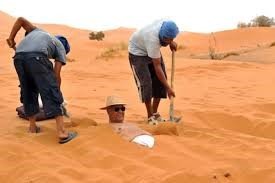
arious types of sand are spread across the Egyptian deserts, distinguished by their unique chemical composition. Some patients resort to these sands in hopes of healing by covering their bodies with sand in what is known as hot sand baths. These sands are believed to be beneficial in relieving bone diseases, rheumatism, and psoriasis. They are also said to enhance skin appearance and help reduce body weight.
However, the very process of burying the body causes fear for some patients, while the high temperature of the sand prevents others from completing the full treatment duration. Therefore, this therapeutic method requires patients who are patient and capable of tolerating heat.
Siwa Oasis is one of the most famous locations where sand baths are practiced for patients suffering from rheumatism, joint pain, and other conditions, in addition to Aswan, South Sinai, the oases, and Safaga.
Warm sand baths are characterized by magnetic waves, mechanical pressure, rapid absorption of solar heat, and the ability to retain it. These elements create a physical therapeutic mechanism with an effective impact on treating many diseases, most notably:
Rheumatism
Arthritis
Chronic lower back pain (lumbago)
Vascular inflammation resulting from blood clotting
Medical reports issued by experts in complementary medicine confirm high success rates for treatment using sand baths, reaching approximately 97% in rheumatism cases and 95% in arthritis, depending on the condition and severity of the disease. It has been observed that most patients who underwent medical follow-up were previously unable to walk without assistance, yet after completing treatment programs, they were able to walk normally.
Although practitioners of sand therapy in Egypt have not formally studied medicine or nursing, they follow similar treatment methods inherited through generations from their parents and ancestors.
Patients are required to eat breakfast at 10:00 a.m., at least three hours before burial, ensuring that the stomach is neither empty nor full. A pit suitable to the patient’s body is prepared several hours before burial in the sand dunes near Mount Dakrour, allowing the pit to be exposed to ultraviolet rays and interact with the surrounding sands.
The patient removes all clothing and is wrapped in a white cloth to allow the body to benefit from the heat of the sand, then covered with a coarse outer garment that balances sand temperature with body temperature. After lying comfortably in the pit, the body is completely covered with sand except for the face. The amount of sand must be moderate—sufficient for therapeutic purposes without exerting excessive pressure on the heart or interfering with normal breathing. A shade is placed over the face to protect it from direct sunlight.
The patient remains buried for about one hour under close supervision. If any feeling of suffocation or discomfort occurs, the sand is immediately removed, even if the burial period was short. Some patients initially express strong desire to undergo burial to relieve their illnesses, but once placed in the pit, fear and anxiety may arise due to the heat of the sand, prompting practitioners to lift them out quickly. Anxiety poses a risk, as it may lead to breathing difficulties and fainting.
Continuous monitoring is maintained, and when the session ends, the sand is gently removed. The patient is immediately covered to prevent exposure to cold air, which could cause serious complications, and remains covered for two hours.
During the short period spent in the hot pit—often no more than fifteen minutes—the patient benefits from minerals present in the sand such as iron and calcium, while excess fluids and toxins are expelled from the body.
Afterward, the patient is removed from the pit, excess sand is shaken off, and the patient is wrapped in a blanket, as the surrounding air—regardless of its actual temperature—feels extremely cold after leaving the sand bath. The patient is then transferred to a closed tent functioning as a sauna.
The patient is given hot drinks such as fenugreek, anise, and licorice, and continues consuming warm beverages. Lunch is then served, consisting of goat soup, poultry meat, and salad. Dinner includes soup, meat, and salad.
In each session, the patient is buried for approximately fifteen minutes. After completing the sand bath sessions, the patient receives a massage with olive oil and apple cider vinegar. Patients are advised not to bathe for two days after the sand baths to allow the body to fully benefit from the sand’s therapeutic effects.
Practitioners have observed that women tend to have stronger hearts and greater tolerance than men during sand bath therapy.
Burial is preferably conducted during the months of June, July, August, and September. Sand therapists claim that the dry climate and mineral salts found in both sand and water contribute significantly to the healing process. The heat of the sand, with temperatures reaching around 40°C, acts like a mechanism that draws toxins out of the patient’s body.
Numerous scientific studies and research conducted on the sands of Mount Dakrour and the mineral- and sulfur-rich springs and wells of Siwa have demonstrated their therapeutic role, revealing the presence of beneficial radiation effective in treating certain chronic diseases.
Local practitioners note that although sand therapy is ancient and traditional, modern science has confirmed its effectiveness. Sand plays a therapeutic role due to its clay mineral content, which generates negative charges when in contact with water, attracting positively charged toxins from the outer layers of the skin.
The presence of small amounts of radioactive minerals such as monazite and thorium contributes to the treatment of skin and bone diseases in particular. Additionally, low concentrations of elements beneficial to the immune system—such as strontium, selenium, and sulfur—along with ultraviolet solar radiation, create a favorable therapeutic environment. Consequently, sand therapy proves effective in treating many diseases.
It is essential to ensure that there are no open wounds or unhealed ulcers on the body before undergoing sand bath therapy.

Address
A.R.E - Giza - Mohandessin 56 Riyadh Street
+211915149000
info@htf-uk.com
Copyright © 2026 [Faculty of Health Tourism]. All rights reserved.